
CROSSROADS Maldives Achieves Official OECM Status, Advancing Singha Estate and S Hotels & Resorts’ Commitment to Marine Conservation
เกริก บุณยโยธิน
14 October, 2026 at 15.44 pm
The recognition of the Maldives’ largest OECM area demonstrates how responsible tourism can contribute to measurable conservation outcomes.

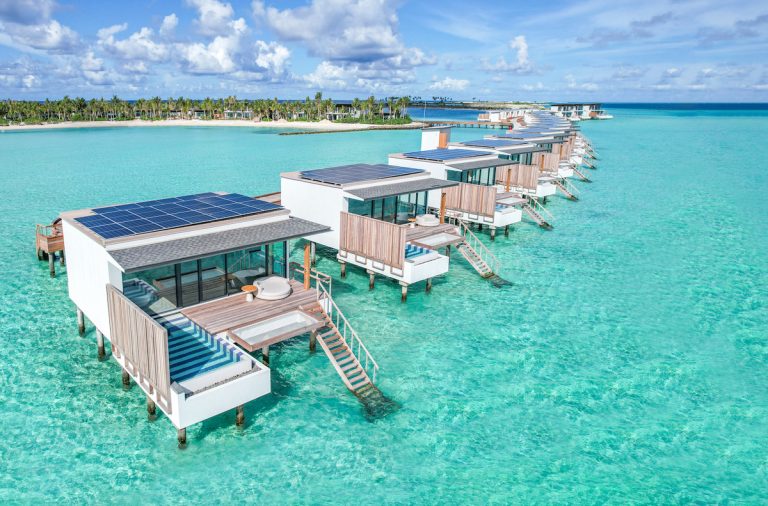
CROSSROADS Maldives, the Indian Ocean’s premier integrated leisure destination and flagship project of S Hotels and Resorts Public Company Limited (SHR), a hospitality arm of Singha Estate (S), part of the Boon Rawd Brewery Group, has reached a significant conservation milestone, with a 1.71-square-kilometre area within the destination officially recognised as an Other Effective Area-Based Conservation Measure (OECM) by the Maldives’ Ministry of Climate Change, Environment & Energy. This recognition marks an important step for CROSSROADS Maldives and the Maldives’ wider efforts to advance nature conservation alongside sustainable tourism development.

The conserved area forms an important ecological corridor adjacent to three resorts within CROSSROADS Maldives: SAii Lagoon Maldives, Curio Collection by Hilton, Hard Rock Hotel Maldives and SO/ Maldives.
Endorsed by Ministry of Climate Change, Environment and Energy, OECMs (Other Effective Area-Based Conservation Measures) are areas that contribute to the long term, effective, in-situ conservation of biodiversity beyond traditional protected areas. These sites are managed by CROSSROADS OECMs management unit in collaboration with a diverse range of stakeholders, including local communities, private sector organisations, and government agencies.
Spanning 1.71 square kilometres across a designated area of Emboodhoo Lagoon in South Malé Atoll, the CROSSROADS OECM is the largest recognised OECM area in the Maldives, supporting the conservation of the lagoon’s marine and coastal ecosystems.
From its inception in 2019, the destination has prioritised measurable conservation outcomes by balancing conservation, controlled recreation, sustainable use and impact mitigation. Drone surveillance, underwater cameras and GPS monitoring ensure compliance and transparency across the conserved area. As a result, the site supports a rich and diverse coral ecosystem, with more than 37 coral genera and 177 reef fish species recorded It also serves as a nursery and feeding ground for 24 species listed on the IUCN Red List, including Hawksbill Turtle, Ornate Eagle Ray, Bowmouth Guitarfish, Giant Guitarfish and Scalloped Hammerhead, all classified as Critically Endangered (CR) and recorded within the CROSSROADS OECM area, alongside other shark species and sea turtles. The OECM also safeguards a key migration route for spinner and bottlenose dolphins, with sighting probabilities reaching 86%.

Mr. Chairath Sivapornpan, CEO of Singha Estate, said: “The recognition of CROSSROADS Maldives as an OECM demonstrates that integrating nature into business decisions from the outset can deliver measurable results. In biodiversity-rich destinations, development should begin with understanding and preserving nature’s intrinsic value for the long term.


At Singha Estate, we work closely with experts, government agencies, partners, and local communities to align business growth, tourism, and conservation. We see biodiversity as a vital asset and foundation for long-term business value. This OECM recognition reflects our ongoing commitment and marks another step towards the global 30×30 target, reinforcing our ambition to create lasting value for business, nature, society, and local communities across every destination in which we operate.”
At CROSSROADS Maldives, this commitment is strongly reflected in the day-to-day management of the destination, supported by continuous monitoring, research and collaboration with local and national partners.